Key takeaways
The 1940 nm wavelength is of interest for endovenous laser treatment (EVLT) because it lies near a strong water absorption band. Its localized absorption profile can support vein wall treatment at relatively low optical power. Clinical performance depends on the complete system and treatment protocol, rather than wavelength alone.
GK Semiconductor develops 1940 nm semiconductor laser chips and fiber-coupled modules for medical device integration. Chip performance, optical coupling, thermal management, and feedback control all influence system size, operating stability, and service life.
1. How 1940 nm interacts with tissue
Strong absorption by water
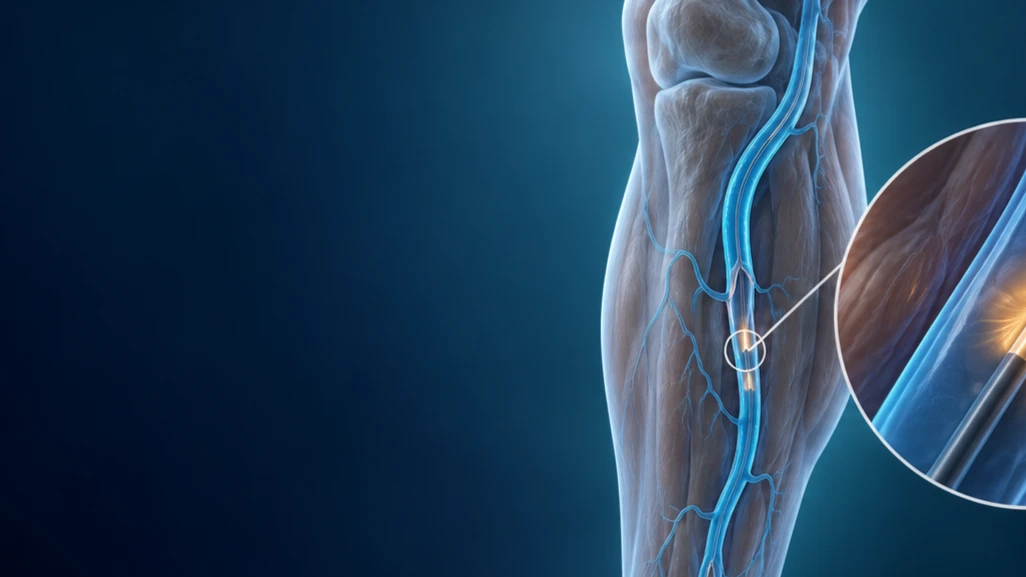
At 1940 nm, water absorbs laser energy strongly. Absorbed energy is converted into heat, contributing to thermal injury, contraction, and subsequent closure of the treated vein. The wavelength is near a strong water absorption band; it should not be described as the universal maximum absorption wavelength of water.
Energy deposition within the vein
Compared with 980 nm, the 1470 nm and 1940 nm wavelengths are more strongly associated with water absorption. However, energy delivery in EVLT involves blood, the vein wall, the fiber, and thermal transport. Describing the process as exclusively targeting the wall with no interaction with blood oversimplifies the mechanism.
Optical penetration and thermal effects
High water absorption produces a relatively shallow optical penetration depth. This is distinct from the depth of tissue heating or injury. Tissue composition, temperature, delivered energy, and exposure time can all affect the thermal response. Shallow optical penetration does not eliminate the risk of nerve or skin injury.
2. Comparing common EVLT wavelengths
| Parameter | 1940 nm | 1470 nm | 980 nm |
|---|---|---|---|
| Absorption profile | Strong water absorption | Water absorption | Water and hemoglobin contribute |
| Optical energy distribution | More localized absorption in water-rich tissue | Less localized than 1940 nm in water | Lower water absorption than longer EVLT wavelengths |
| Power selection | Low-power protocols are used; settings require device-specific validation | Protocol and device dependent | Protocol and device dependent |
| Clinical outcome | High closure rates reported; complications remain possible | Established EVLT wavelength; complications remain possible | Outcomes depend on fiber technology and protocol |
| Cosmetic claims | Skin tightening and facial use need separate evidence | Skin tightening needs separate evidence | No blanket cosmetic comparison is established |
This comparison describes general wavelength characteristics. It is not a treatment protocol or a substitute for device-specific clinical validation.
3. GK Semiconductor chip and module technology
Proprietary 1940 nm semiconductor laser chips
GK Semiconductor uses an antimonide-based quantum-well material system for its 1940 nm laser chips. The specified center emission wavelength is 1940 ± 5 nm. Chip design and electrical-to-optical conversion performance support efficient optical output and compact system development.
Burn-in and extended operating tests are used to evaluate reliability and output stability. Spectral performance, lifetime, and operating limits should be specified for the selected chip and its intended conditions.
Fiber-coupled laser modules
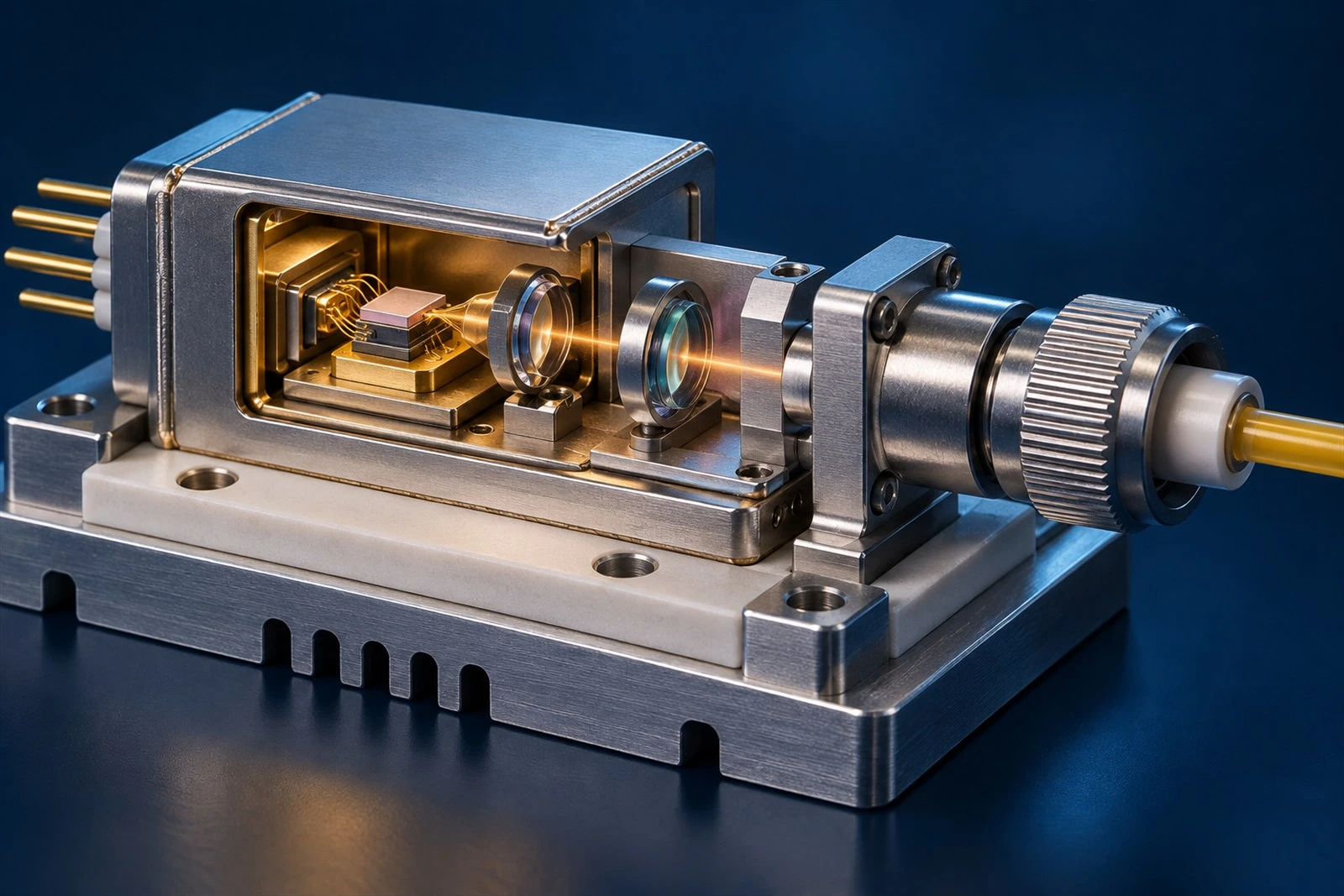
The modules specify a stable output of 5–6 W and coupling efficiency above 90%. Short-focal-length optics and precision assembly support optical coupling. An aluminum nitride ceramic heat sink and hermetic parallel seam-welded package support thermal management and integration.
Precision temperature control, optical power monitoring, high-power fiber connectors, and protective metal sleeves support stable operation. Correct handling and clean optical interfaces remain essential to reduce the risk of contamination and end-face damage.
4. Technical questions from engineers and R&D teams
How can 1940 nm support smaller system designs
Lower required optical output in an appropriately validated treatment protocol can reduce some power and thermal management demands. The final cooling architecture depends on electrical-to-optical efficiency, duty cycle, ambient conditions, and the complete system design. A fixed reduction in heat sink or power supply size cannot be inferred from wavelength alone.
Can fiber end-face damage or power degradation occur
Yes. Contamination, back-reflections, connector damage, and overheating can affect fiber-coupled systems. Suitable connectors, optical power monitoring, thermal management, and proper handling help reduce these risks, but do not eliminate them.