 Key Takeaways at a Glance
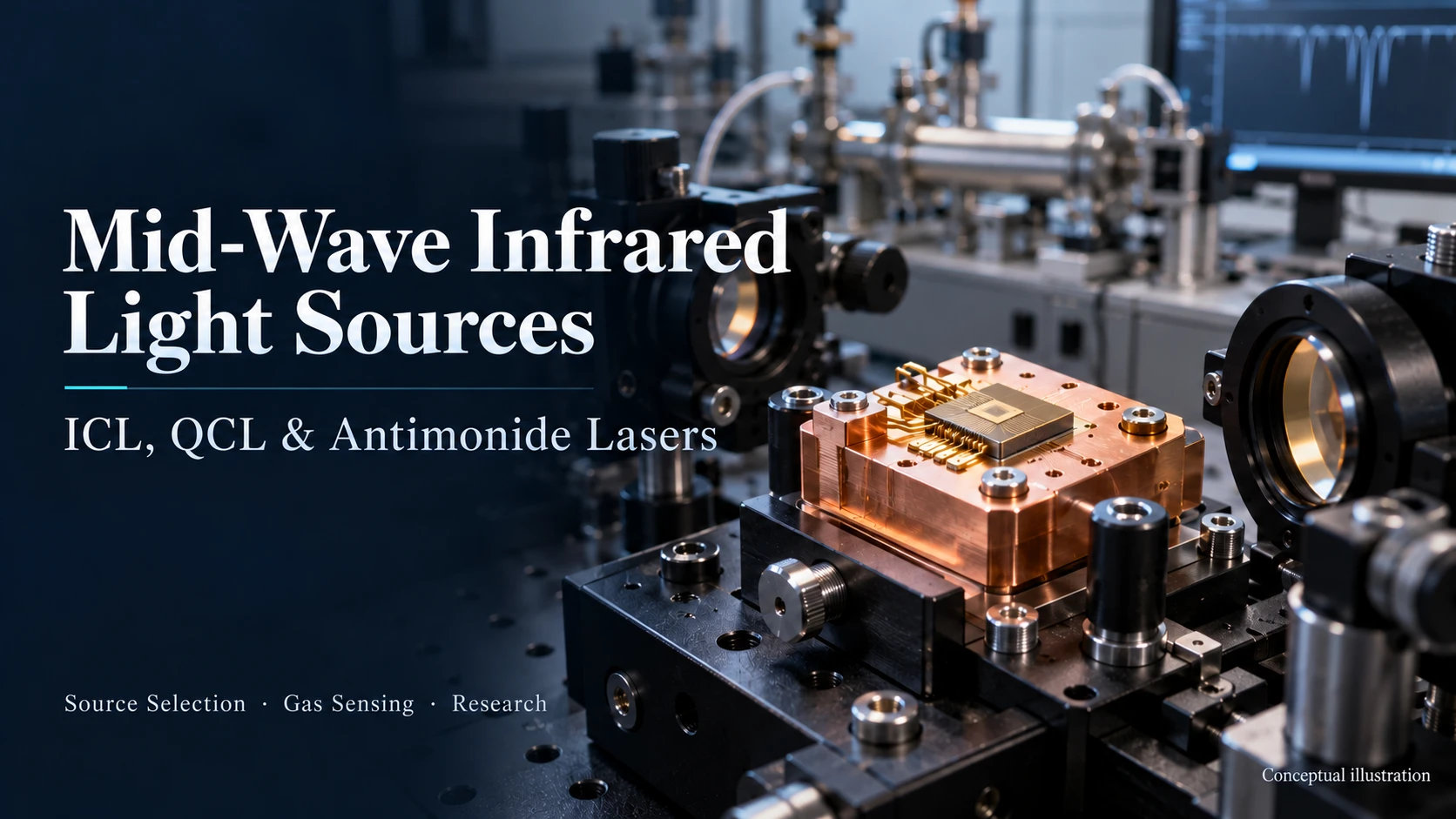
The workhorses of 3–5 μm MWIR light sources are cascaded lasers, split along two routes. ICLs (interband cascade lasers) rely on interband transitions, usually with lower threshold current and power consumption, and are the common pick for gas sensing and active IR illumination; QCLs (quantum cascade lasers) rely on intersubband transitions, with wider wavelength coverage and higher output power. What GK Semiconductor ships in volume is GaSb-based laser chips and bars in the 2–3 μm range (2100 nm, 2700 nm). In the 3–5 μm band, the ICL and detector directions are on the roadmap, with models and specs to be confirmed project by project.
Questions This Article Answers
How ICL and QCL differ | why gas sensing uses MWIR sources | what the antimonide platform is | what GK Semiconductor actually supplies in MWIR today, and what is still open.
I. The Antimonide Platform: One Material, Two Directions
What sets the antimonide system apart is that the same InAs/GaSb material can serve as a detector and as an MWIR interband cascade laser (ICL). One epitaxy capability supports both detection and emission. That is why 3–5 μm is called antimonide's home turf.
For the material landscape and cooling requirements on the detection side, see MWIR 3–5 μm Detectors: Materials, Cooling, and Type-II Superlattices. This article covers the source side only.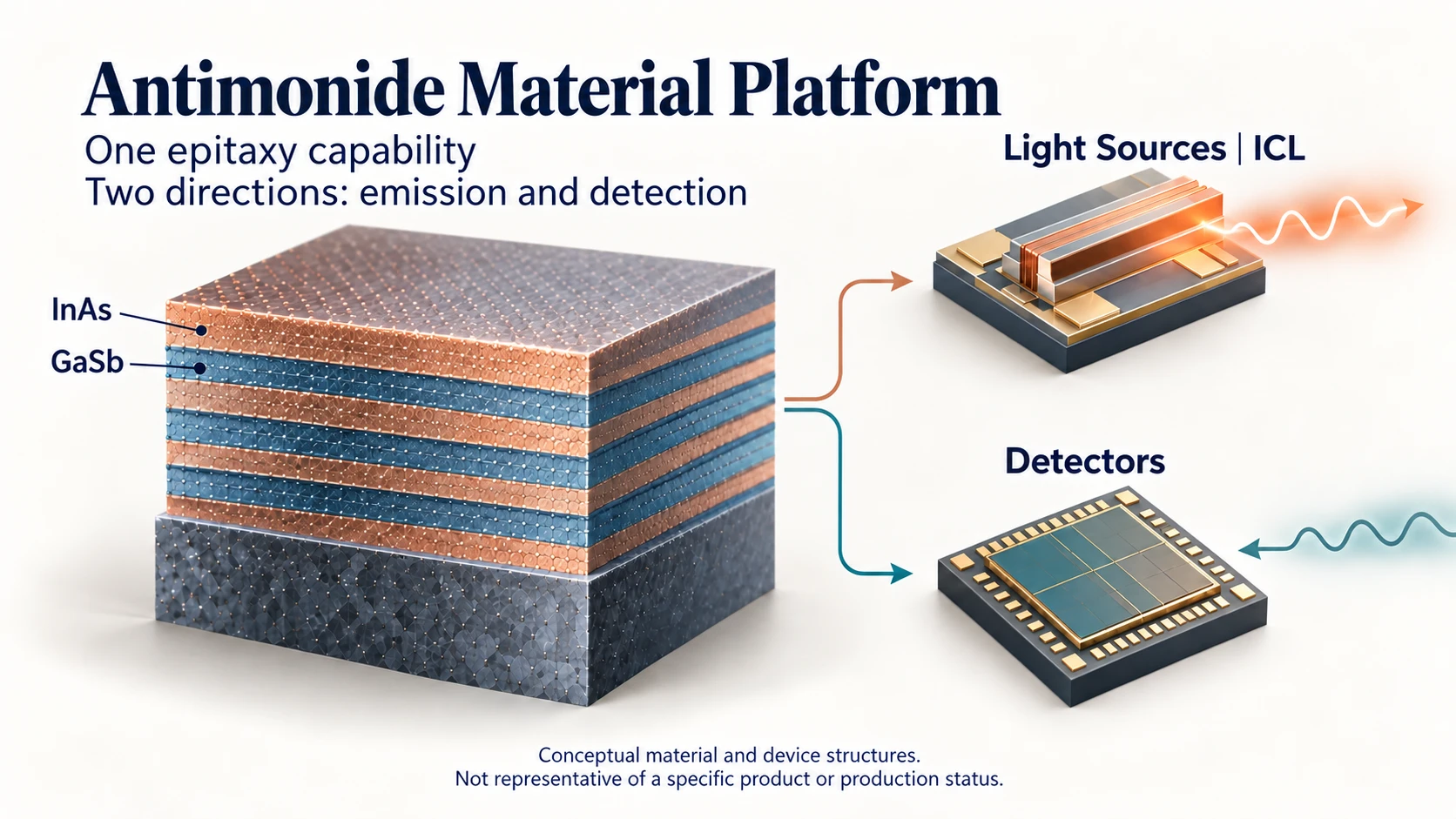
II. ICL: The MWIR Cascaded Source
An ICL stacks multiple active regions in series. An electron passes through each stage in turn, and every stage emits a photon. One electron therefore contributes multiple photons, and at moderate current you get higher output than a conventional semiconductor laser.
Its emission lands in the 3–5 μm MWIR band, right on the strong absorption lines of many gases, which makes it the workhorse source for gas sensing and active IR illumination.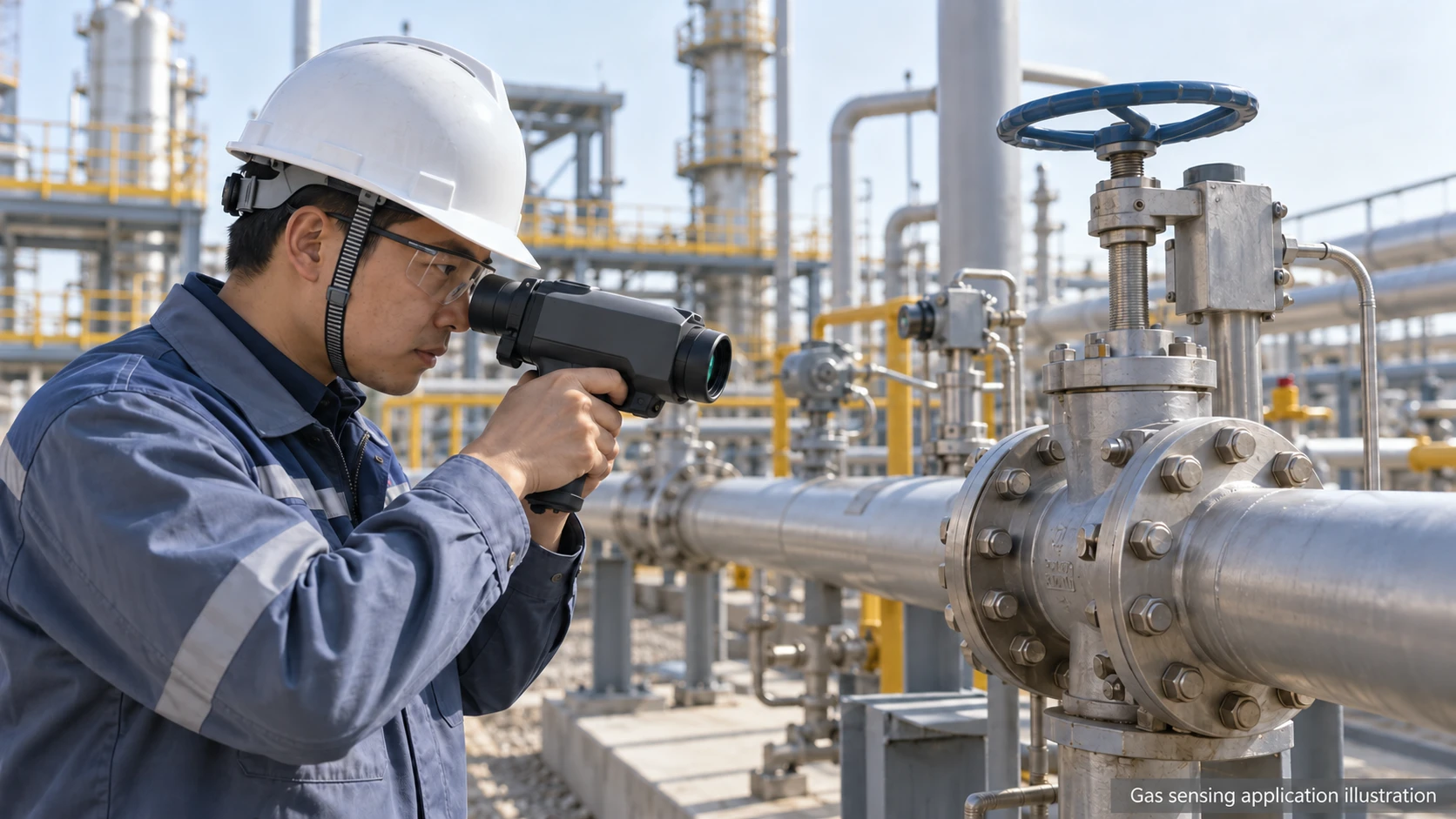
III. How ICL and QCL Differ
The one easily confused with it is the quantum cascade laser (QCL). Both are "cascaded," but the physics differ: ICL uses interband transitions, QCL uses intersubband transitions. The material systems differ too — QCL predominantly runs on InGaAs/AlInAs (InP-based).
ICL threshold current and power consumption are usually lower than QCL's; QCL covers a wider wavelength range and delivers higher output power. Selection comes down to the specific band and power budget — don't mix the two up by name.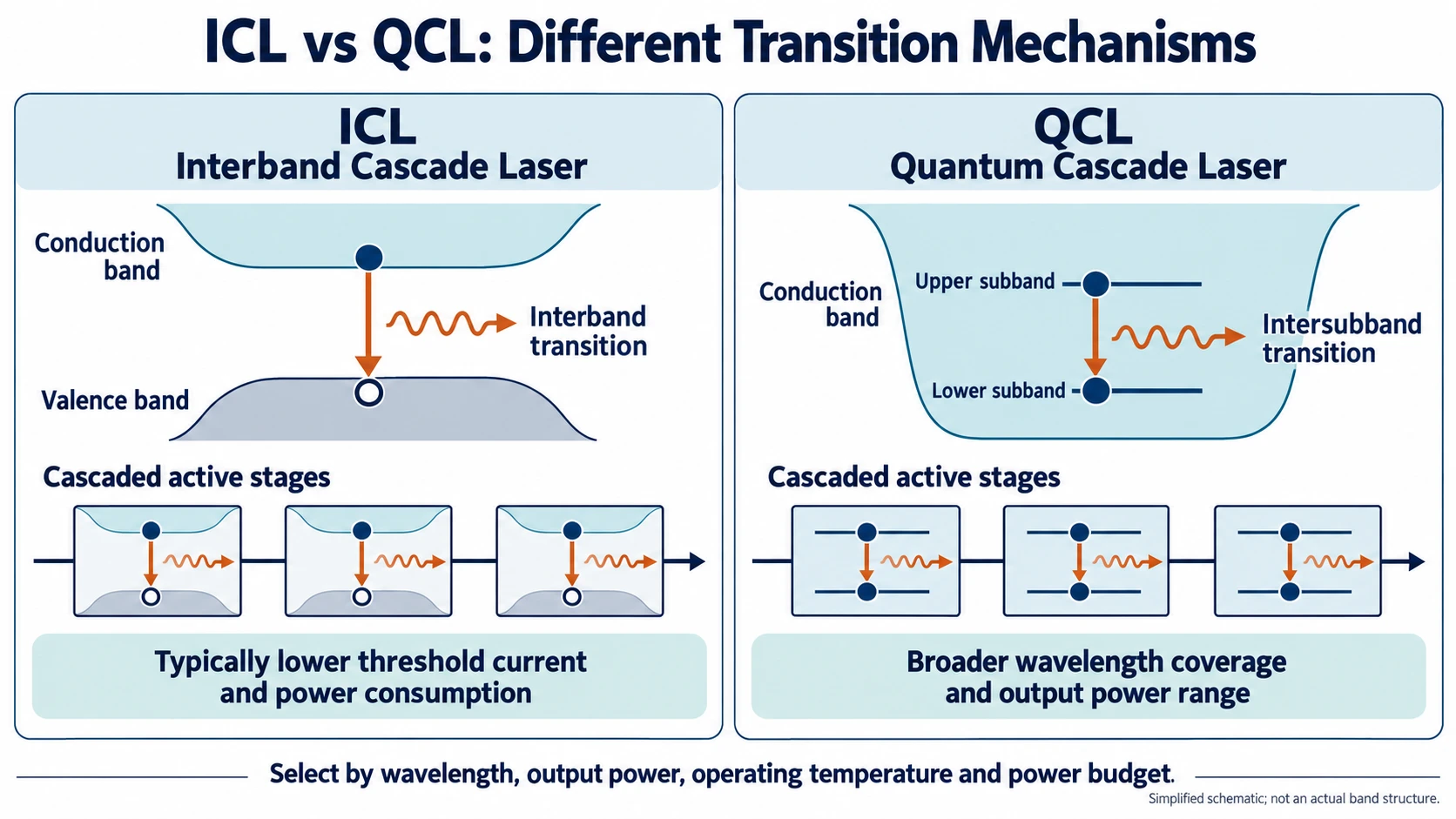
IV. What GK Semiconductor Actually Supplies on This Line
Source side, in volume. The 2100 nm 500 mW chip (GKCP-2100-500M-CW-00) and the 2700 nm bar (GKBAR-2700-XX0M-CW-00) are GaSb-based and sit in the mid-IR. Both bands carry a technical barrier and a competitor count on a different order from conventional near-IR.
Single-frequency and tunable. Jincheng Guoke focuses on 1950 nm single-frequency and tunable narrow-linewidth semiconductor lasers, with volume production capability for antimonide lasers in the 1.8–3.0 μm mid-IR single-frequency direction, benchmarked against research-grade sources. This line mainly serves research, differential absorption LiDAR, and remote sensing, where the buying logic differs from industrial volume parts. See product catalog P-20 and P-21.
Detectors and ICL. On the roadmap; specific models, array sizes, operating temperatures, and detectivity are confirmed project by project. No numbers here.
FAQ
Q1 Are ICL and QCL the same thing?
No. ICL uses interband transitions, QCL uses intersubband transitions, and the material systems differ. ICL threshold power is usually lower; QCL covers a wider wavelength range and higher output power.
Q2 Can GK Semiconductor supply 3–5 μm detectors now?
The antimonide MWIR/LWIR detector direction is on the roadmap; specific models, array sizes, operating temperatures, and detectivity must be confirmed project by project. What ships in volume today is the 2100 nm and 2700 nm antimonide lasers on the source side.
Q3 Why use MWIR sources for gas sensing?
Many gases have strong absorption lines in the 3–5 μm band, and the ICL emission wavelength lands right on those lines, which is why it is the workhorse source for gas sensing and active IR illumination.