 I. Summary
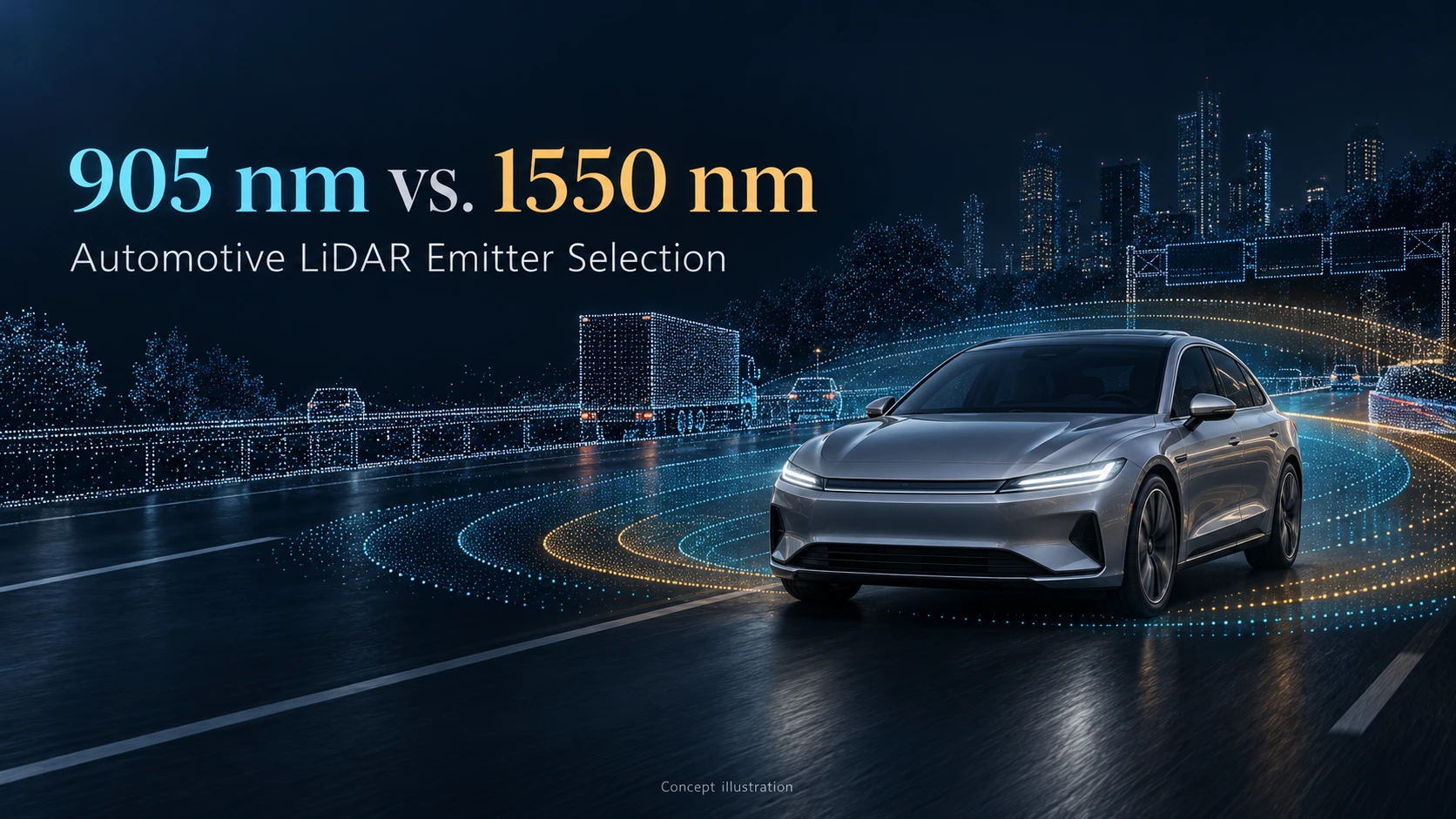
Automotive LiDAR transmitters today split into two camps: 905 nm near-infrared, and the 1550 nm eye-safe band.
The 905 nm supply chain is mature, single-chip cost is low, and silicon detectors respond to it directly. The 1550 nm band carries a higher eye-safety threshold, so a complete system can emit more optical power while staying inside the safety standard. The price is costlier components and a more complex architecture.
The two routes suit different detection-range targets, budgets, and production volumes. Settle four inputs first — target detection range, system power and thermal budget, per-unit cost ceiling, annual volume — and the wavelength usually picks itself.
II. Emitter Device Categories: Laser Diodes and Fiber Lasers
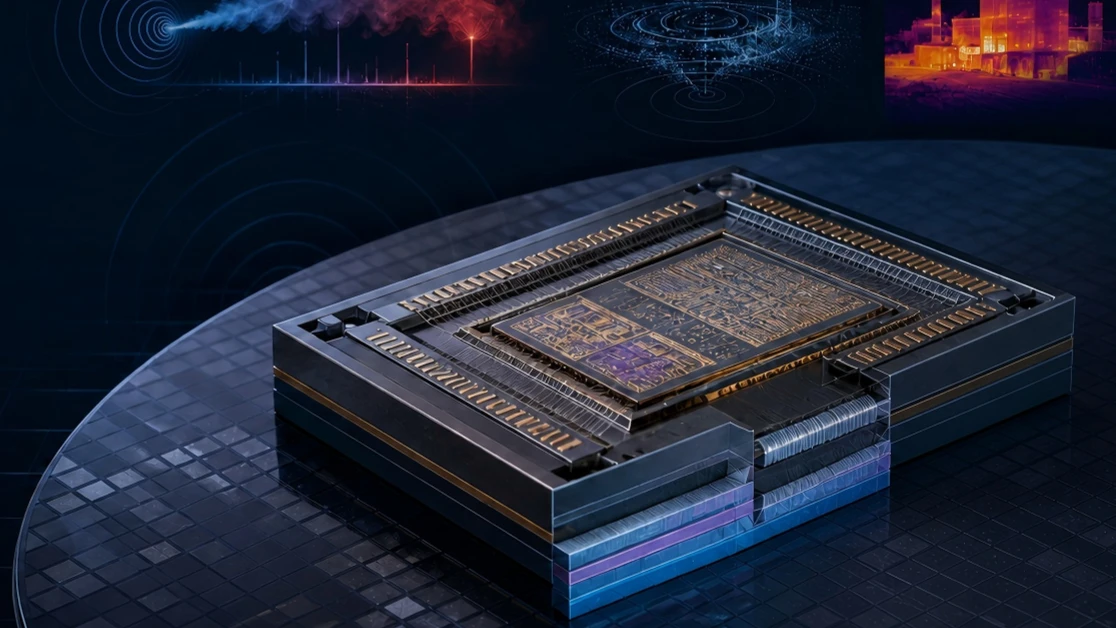
A LiDAR transmitter starts with one of two device categories: the laser diode (LD) — a semiconductor device that lases from a p-n junction — and the fiber laser system. Do not confuse the laser diode with the light-emitting diode (LED): an incoherent, spontaneous-emission source that cannot serve as a LiDAR transmitter.
Within the laser-diode category, the 905 nm route splits into two structures that are not interchangeable: edge-emitting (EEL) and vertical-cavity surface-emitting (VCSEL).
A 1550 nm fiber laser is not a diode at all. Its emitter is an erbium-doped fiber amplifier; only the seed source is a laser diode — a system-level product, not a single-device purchase.
| Category | Form | Emission geometry | Typical wavelength | Engineering implication |
| Laser diode (LD) | Edge-emitting laser (EEL) | Light exits from the chip sidewall | Mainly 905 nm | Small emitting area, can be stacked vertically into multiple junctions, capable of very high pulsed peak power — the workhorse for long-range and mid-to-long-range LiDAR |
| Laser diode (LD) | Vertical-cavity surface-emitting laser (VCSEL) | Light exits perpendicular to the chip surface | Mainly 905 nm | Can be built into 2D arrays; circularly symmetric spot, easy to integrate — common in short-range blind-spot fill and consumer ranging |
| Fiber laser system (not a diode) | 1550 nm fiber laser solution | Seed source + fiber amplifier | 1550 nm | Requires a fiber amplification chain; bulkier and costlier than a directly driven semiconductor chip |
So a customer who has settled on the 1550 nm route usually needs a complete 1550 nm fiber-laser transmitter solution, not a laser diode — 1550 nm laser diodes do exist, but their power levels suit seed sources or low-power ranging, not long-range automotive LiDAR. Confirm the form factor first, then talk parameters.
Shanxi Guoke Semiconductor Optoelectronic does not currently make 1550 nm emitter chips. Our 905 nm transmitter products are edge-emitting pulsed laser chips, shipped as bare die for the customer to package and drive, in three junction-count grades: triple, quad, and six-junction. On the eye-safe NIR side, we sell 1535 nm ±5 nm and 1570 nm ±10 nm laser rangefinder systems, with models covering 3 / 4 / 6 / 12 / 15 km and OPO. See the laser rangefinder pages in the Guoke Product Handbook 0803.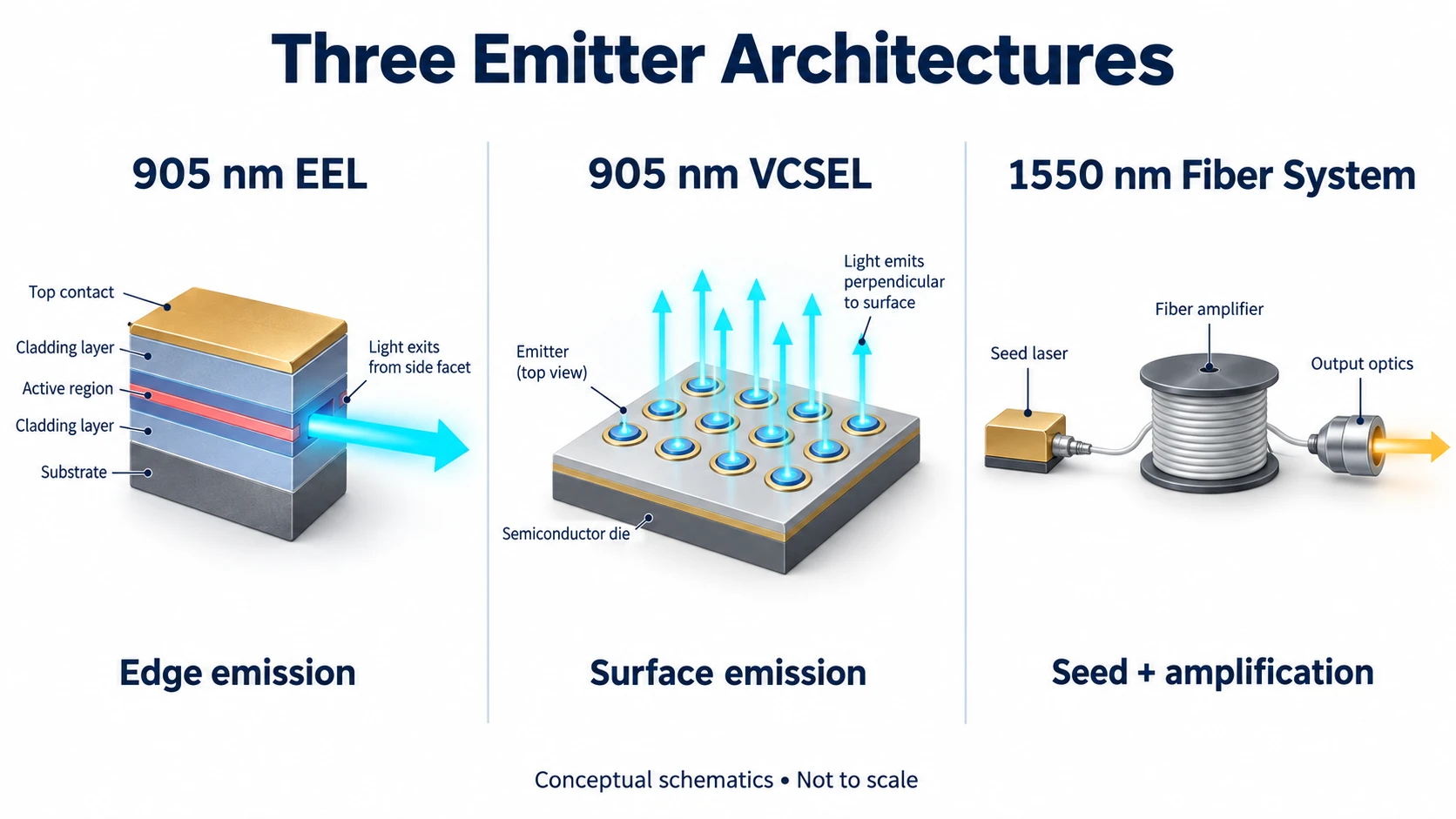
III. 905 nm vs. 1550 nm: Six Points of Comparison
| Item | 905 nm | 1550 nm | Notes |
| Band | Near-infrared — invisible to the eye, but focused onto the retina by the lens | Eye-safe band; the industry generally means 1400 nm and above | Most 1550 nm light is absorbed by water in the front of the eye before it reaches the retina |
| Safety threshold | Held to relatively tighter constraints under laser safety standards | Higher threshold, permitting greater emitted power | "Eye-safe" does not mean absolutely harmless — the final safety class is set by the system design |
| Detector | Silicon detectors respond directly | Usually requires non-silicon detectors such as InGaAs | Directly drives detection-module cost |
| Supply chain | Materials, packaging, and driver chains are all in place | Lower degree of scale | Determines lead times and future cost-down room |
| Cost structure | Bare die; the customer packages it, so cost concentrates in the chip itself | Needs a fiber amplification chain and non-silicon detectors; higher device and system cost | Actual cost varies with annual volume and packaging approach |
| Atmospheric attenuation | In public literature, 905 nm attenuation in rain and fog is usually listed as its weakness | Public literature carries two opposite conclusions — one that 1550 nm suffers greater rain/fog attenuation through water absorption, another that it penetrates smoke better | This item stays open pending verification. Ask suppliers for measured data under your specific conditions rather than locking in on a single conclusion |
The cost and supply-chain rows come from our own read on the LiDAR industry: unit prices are pressed hard and volumes are large, so customers are sensitive to both price and batch consistency.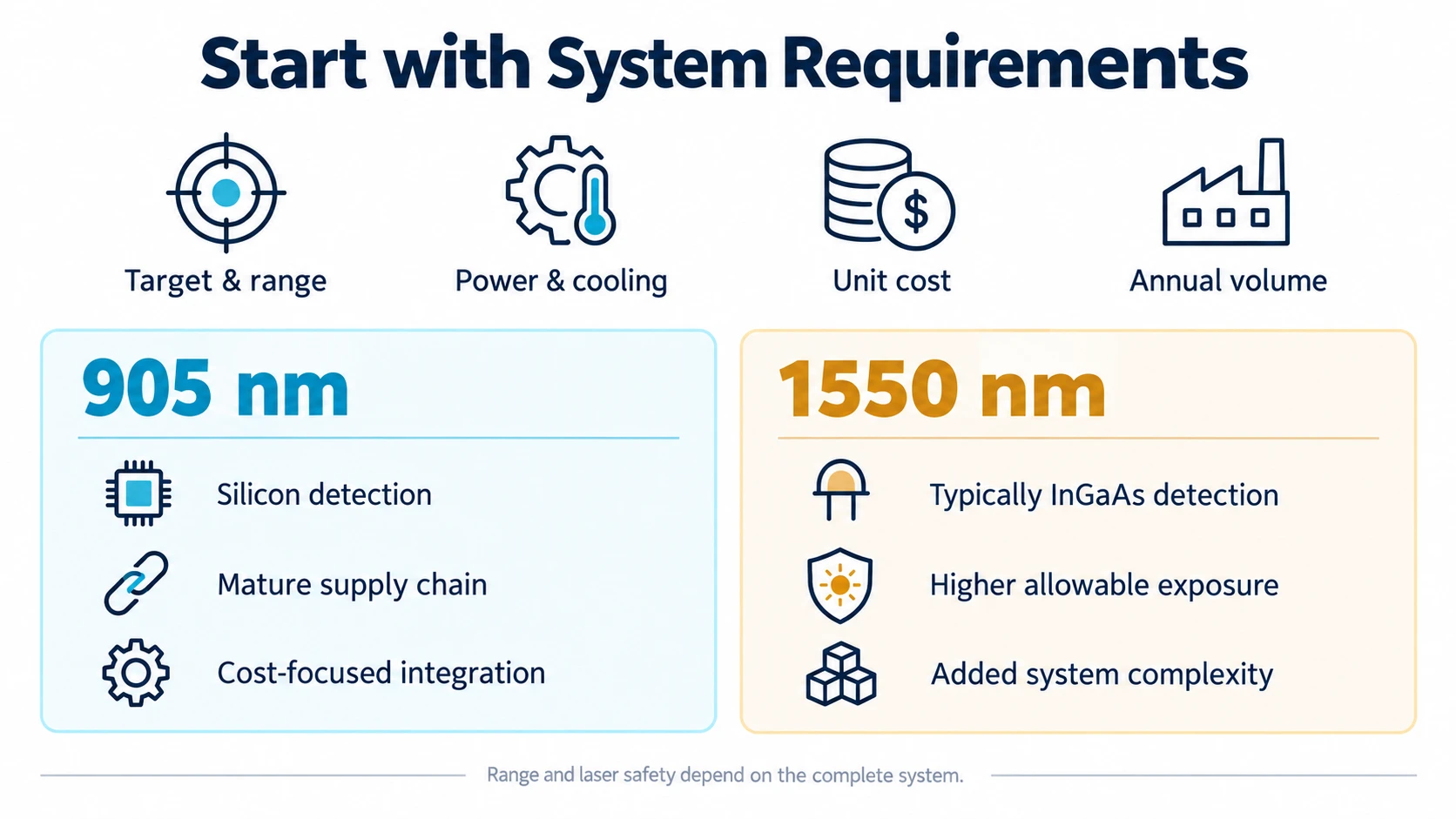
IV. Who the 1550 nm Route Suits
Read against the comparison above, a 1550 nm solution fits when all three conditions hold at once.
l Detection range is the primary metric, and the system is willing to trade cost for a higher safety threshold and more transmit power.
l Cost sensitivity is low, or annual volume is not yet enough to amortize the fiber amplification chain.
l The system team has the integration capability for non-silicon detectors and fiber optics.
Conversely, if the program is in a cost-cutting phase, annual volume runs above 10,000 units, or the system team wants to change as little of its existing optics and detection scheme as possible, 905 nm is the safer starting point. Our judgment here rests on the cost and supply-chain rows in Section III.
Once 905 nm is settled, the chip-side parameter conventions and grade breakdown are covered in the companion piece, "How to Choose a 905 nm Pulsed Laser Chip: Seven Key Parameters and the Multi-Junction Power Ladder."
V. Selection Checklist: Answer Six Questions First
l What is the target detection range, and against what target? A vehicle is 2.3 m × 2.3 m; a drone is a small target on the order of 0.1 m². Different target sizes are not comparable at all.
l What power and thermal budget does the system allow? Duty cycle and junction count drive this directly.
l What is the per-unit cost ceiling, and what order of magnitude is annual volume? Volumes above 10,000 change the entire business case.
l What are the existing optical system and detector scheme, and how much would a wavelength change cost?
l How capable is the customer's own driver circuit? The 240 W grade calls for driver design capability at the 40 V / 33 A level. Without it, step down a grade.
l Is the program at prototyping or in volume production? Haggling over price at the sample stage is a mistake — settle technical fit first.
VI. Two Common Misconceptions
Misconception one: reading "eye-safe band" as "harmless to the eye."
The accurate statement is that bands above 1400 nm, such as 1550 nm, are eye-safe bands whose maximum permissible exposure (MPE) is far higher than at 905 nm, making it easier to stay within a safe laser class at the same emitted power. That does not mean you can shine them into an eye at will. Any laser operation requires protective eyewear matched to the wavelength.
Misconception two: assuming 1550 nm must beat 905 nm.
What 1550 nm buys is margin on the safety threshold and transmit power. What it costs is money and architectural complexity. In low-cost, high-volume automotive programs, 905 nm remains the mainstream choice.
VII. FAQ
Q1 What wavelength do automotive LiDAR emitters typically use?
Mainstream today is 905 nm near-infrared, where the emitter is typically a laser diode in one of two structures: edge-emitting (EEL) or vertical-cavity surface-emitting (VCSEL). Long-range schemes with tighter safety-threshold requirements turn to the 1550 nm fiber laser route — a system-level solution, not a laser diode.
Q2 Which sees farther, 905 nm or 1550 nm?
You cannot compare them without fixing the conditions. 1550 nm has a higher safety threshold, so it may emit more power within the safety standard and carries more range potential under identical optics. Real detection range also depends on target reflectivity, atmospheric visibility, detector sensitivity, and the algorithm.
Q3 Is 905 nm safe for the human eye?
905 nm is a wavelength that requires dedicated design work under laser safety standards. Shorter pulse widths and lower duty cycles help a system meet the standard. The final safety class is set by the customer's system design; we do not provide safety endorsements on a customer's behalf.