I. Summary
Choosing a 905 nm emitter chip is a two-step process.
Step one: read the seven key parameters — lasing wavelength and tolerance, peak output power, pulse width, duty cycle, junction count, divergence angle, operating temperature range. These seven decide whether the chip lines up with the system's optical filters, detector response band, power supply, and driver design.
Step two: pick a grade along the triple / quad / six-junction power ladder. Triple-junction 15 W / 75 W covers short and mid range; quad-junction 40 W / 90 W is the mid-to-long-range workhorse; six-junction 240 W with a 5 ns pulse targets long-range, high-precision imaging. Every step up raises the range margin and the bar for the driver circuit together.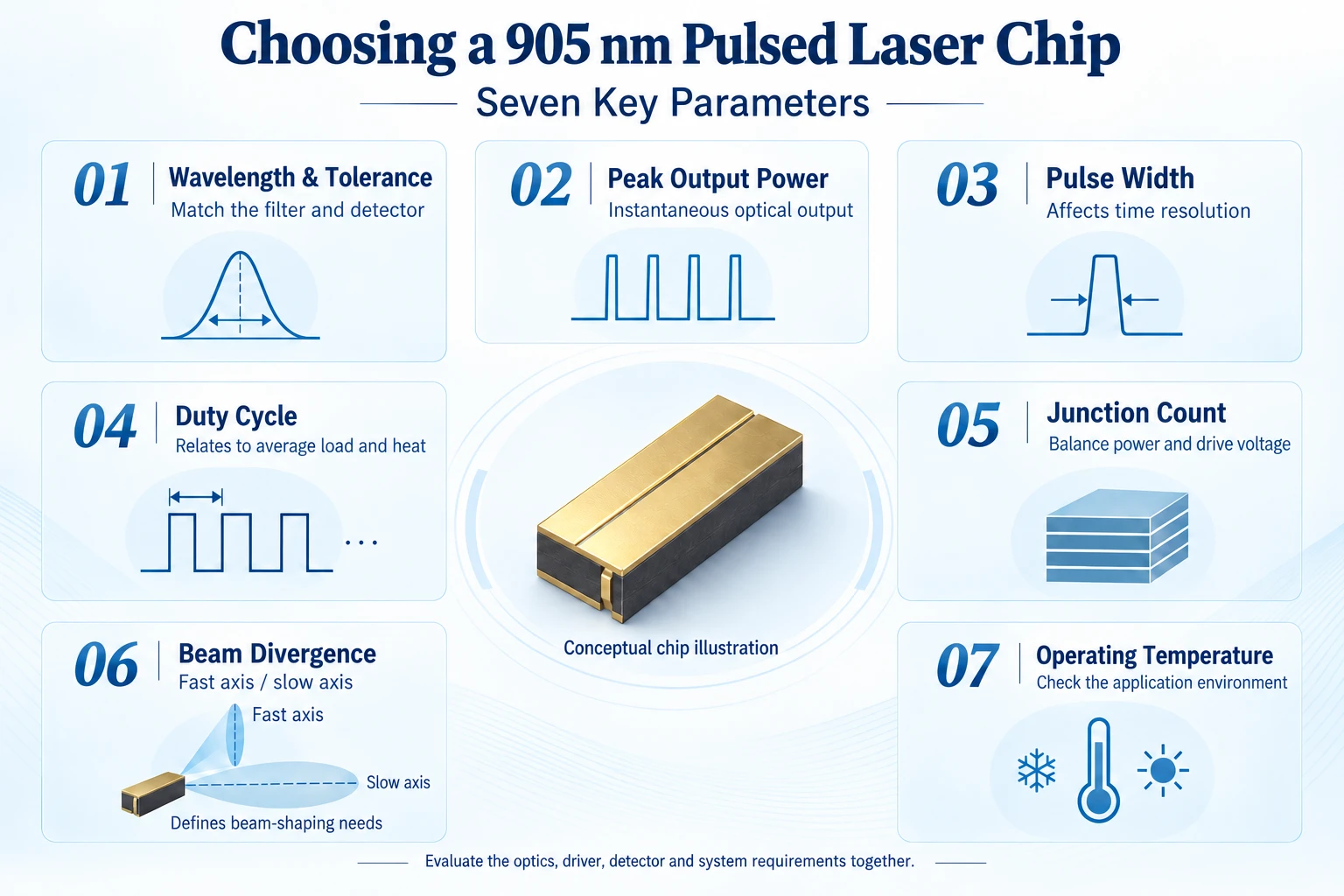
II. Reading the Seven Key Parameters of a 905 nm Emitter Chip
When a 905 nm emitter chip datasheet lands on your desk, read these seven first.
Lasing wavelength and tolerance. 905±10 nm means a 905 nm center wavelength with batch deviation held within ±10 nm. The wavelength must match the system's optical filters and detector response band.
Peak output power. The power at the instant the pulse fires, and the number is large. It cannot be compared directly against continuous or average power. That is an amateur mistake, and it gets called out on the spot in a technical review.
Pulse width. The time from pulse onset to end. The shorter the pulse, the finer the single-shot time resolution and the better the theoretical ranging precision.
Duty cycle. The fraction of the period the pulse occupies. The lower the duty cycle, the less average heat and the lighter the thermal design load on the system.
Junction count (number of stacked active regions). For the same chip area, more junctions means higher peak power. The trade-off is a correspondingly higher operating voltage.
Divergence angle (fast axis / slow axis). This sets the difficulty of beam shaping and the design space available to the optics.
Operating temperature range. Automotive applications must check this one. All three 905 nm pulsed chips we sell are rated -15 to 85 °C. See the next section.
III. Common Chip Specifications (Guoke Semiconductor products as examples)
Triple-junction 905-15W-PL / 905-75W-PL
| Parameter | 905-15W-PL | 905-75W-PL |
| Lasing wavelength | 905±10 nm | 905±10 nm |
| Peak output power | 15 W | 75 W |
| Spectral width (FWHM) | 7 nm | 7 nm |
| Fast-axis divergence | 22° | 30° |
| Slow-axis divergence | 8° | 10° |
| Emitting area width | 40 μm | 300 μm |
| Threshold current | 1 A | 1 A |
| Operating current | 6 A | 22 A |
| Operating voltage | — | 18 V |
| Pulse width | 100 ns | 100 ns |
| Duty cycle | 0.1% | 0.1% |
| Number of emitting stripes | 3 | 3 |
| Cavity length | 0.6 mm | 0.8 mm |
| Chip thickness | 120–130 μm | 120–130 μm |
| Operating / storage temperature | -15 to 85 °C / -40 to 85 °C | -15 to 85 °C / -40 to 85 °C |
Quad-junction 905-40W-PL / 905-90W-PL
| Parameter | 905-40W-PL | 905-90W-PL |
| Lasing wavelength | 905±10 nm | 905±10 nm |
| Peak output power | 40 W | 90 W |
| Spectral width (FWHM) | 7 nm | 7 nm |
| FA / SA divergence | 22° / 8° | 22° / 8° |
| Threshold current | 1 A | 1 A |
| Operating voltage | 18 V | 27 V |
| Pulse width / duty cycle | 100 ns / 0.1% | 100 ns / 0.1% |
| Number of emitting stripes | 4 | 4 |
| Cavity length | 0.8 mm | 0.8 mm |
| Operating temperature | -15 to 85 °C | -15 to 85 °C |
Six-junction GKCP-905-240W-PL-110
| Parameter | Value |
| Peak output power | 240 W |
| Lasing wavelength | 905±10 nm |
| Spectral width (FWHM) | 7 nm |
| FA / SA divergence | 22° / 8° |
| Emitting area width | 110 μm |
| Threshold current | 1 A |
| Operating current | 33 A |
| Operating voltage | 40 V |
| Pulse width | 5 ns |
| Duty cycle | 0.01% |
| Number of emitting stripes | 6 |
| Cavity length | 0.8 mm |
| Chip thickness | 120–130 μm |
| Operating / storage temperature | -15 to 85 °C / -40 to 85 °C |
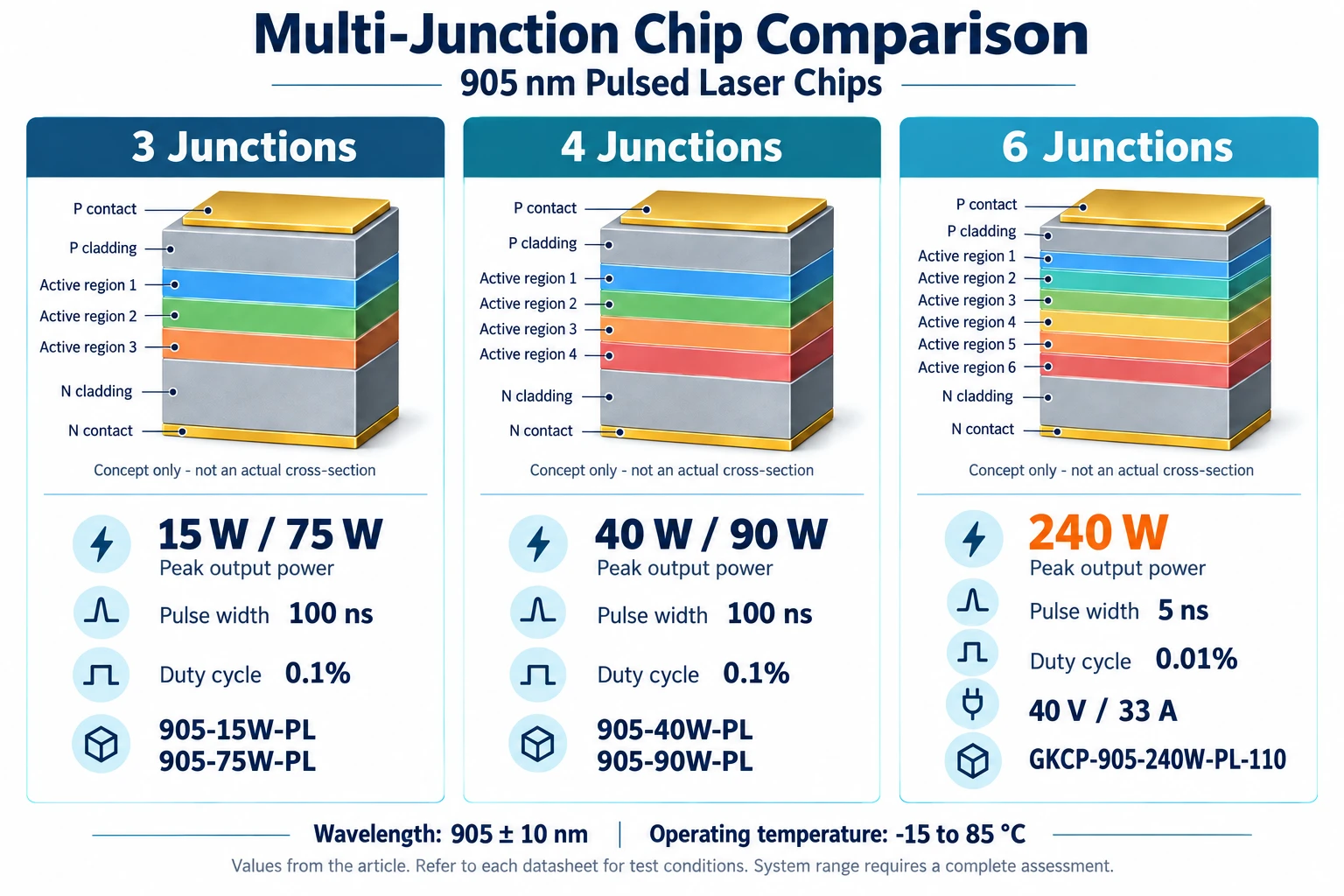 The figures above are the nominal values in the product handbook — typical specifications under defined laboratory conditions. Real system ranging performance also depends on the optics, detector sensitivity, algorithm, and atmospheric conditions. It cannot be derived from chip parameters alone.
IV. Triple, Quad, Six: One Power Ladder
The division of labor across the three grades is clear.
l Triple-junction 15 W / 75 W. Entry-level and short-to-mid range, and the cheapest of the three. It fits price-sensitive applications where detection range is not extreme — robot obstacle avoidance, drone altitude hold, industrial safety light curtains.
l Quad-junction 40 W / 90 W. The mid-to-long-range workhorse. Power steps up at the same footprint, and the power design shifts from low-voltage/high-current to high-voltage/low-current, which is easier on the customer's supply and driver design.
l Six-junction 240 W / 5 ns. The top of this product line. 240 W peak power with a 5 ns ultra-short pulse and duty cycle down to 0.01%, aimed at long-range, high-precision 3D imaging and high-end autonomous-driving perception. Operating voltage 40 V and operating current 33 A require the customer to have dedicated driver-circuit design capability.
When a customer says he wants to "see farther," recommend one grade up this ladder. If the target range falls outside what the six-junction part can deliver, it is a custom requirement — route it through technical evaluation, and make no commitments beyond the handbook.
V. Two Common Misconceptions
Misconception one: comparing your peak power against someone else's average power.
Peak power is the power at the instant of the pulse. Average power folds in both the on and the off time. The two are orders of magnitude apart. Comparing peak against average produces a conclusion with no technical meaning.
Misconception two: treating sample specifications as guaranteed production values, and certification status as a given.
Handbook nominal values are specifications under defined conditions. Production consistency and certification status have to be confirmed item by item. On automotive qualification, our position is that we do not commit to certification status — the technical department answers formally, and we do not issue certification conclusions on a customer's behalf.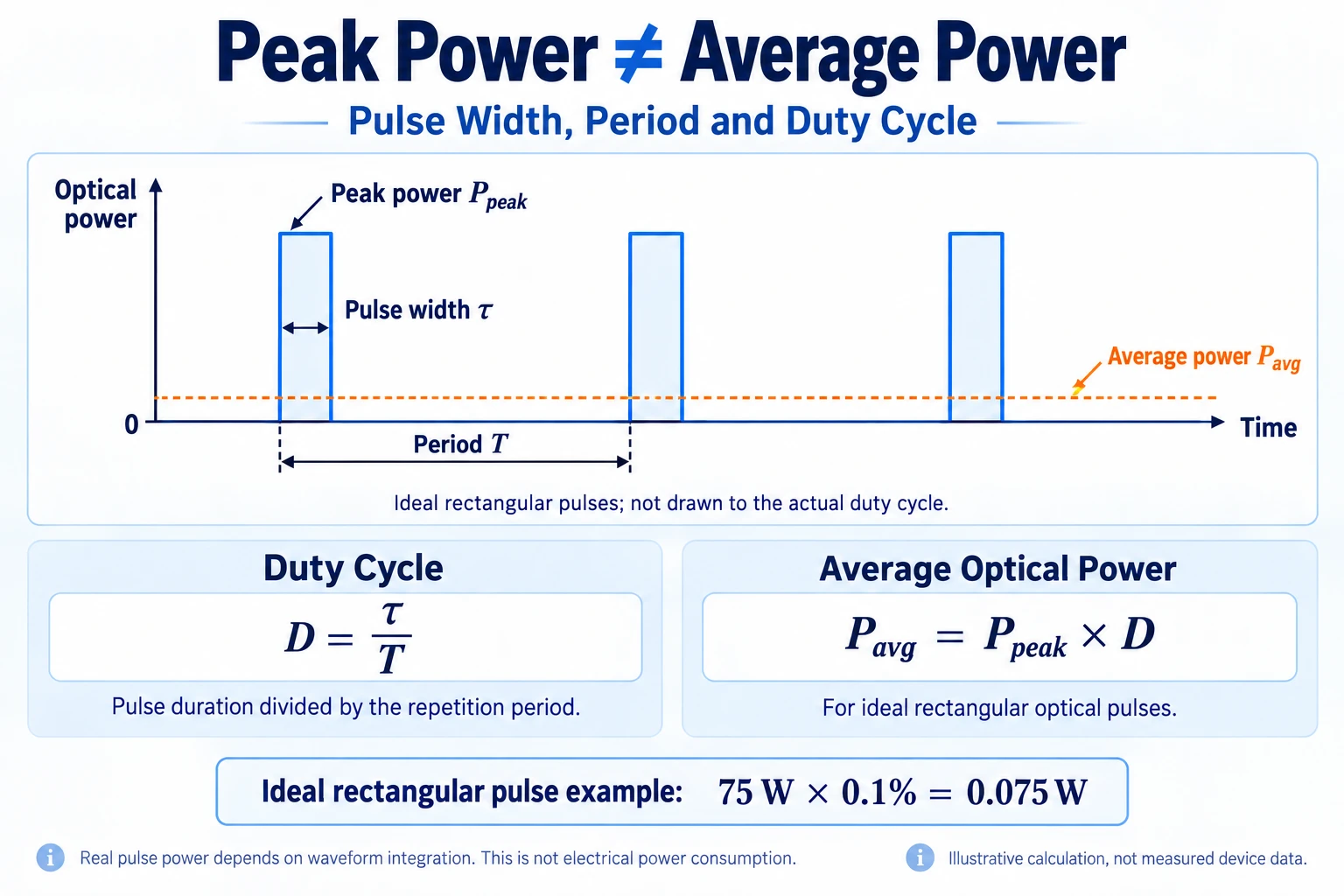
VI. FAQ
Q1 What is the point of multiple junctions (triple / quad / six)?
Stacking several active regions vertically lifts peak power by a grade at essentially the same chip area, letting the customer push for longer range within a limited volume. The higher the junction count, the higher the operating voltage.
Q2 How do I choose between 15 W and 240 W?
Look at the target detection range, field of view, and the system's power budget. This is a technical selection question — gather detection range, field of view, and installed device form factor, then hand it to engineering for a recommendation.
Q3 Can you supply a laser chip that has passed automotive qualification?
We do not commit to automotive qualification status on a public page. The technical department answers formally for a specific part number against a specific standard. Please provide the part number and the target standard, and we will respond through the formal process.